Free Download: Two Spectacular ScIence Magazines
Alfred Russel Wallace Centenary Celebration Edited by Richard Milner
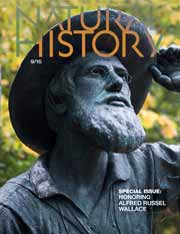
Natural History�s special Alfred Rus�sel Wallace commemorative issue is an intellectual and pictorial feast, featuring rare archival photos, a vintage essay by Stephen Jay Gould, a new bio�graph�ical �appreciation� by Sir Da�vid Attenbor�ough, magnificent birds of paradise photos, excerpts from Wal�lace�s letters, and much more.
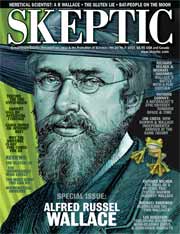
In Skeptic, biologist James Costa shows how Darwin and Wallace inde�pendently discovered natural selection, Richard Milner describes a Victorian courtroom drama over Spiritualism at which they took opposite sides, Mi�chael Shermer writes on �heretic� sci�entists, and animal behaviorist Lee Dugatkin challenges Wallace�s views about human cognition.
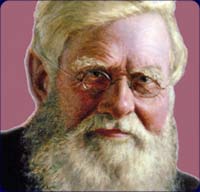
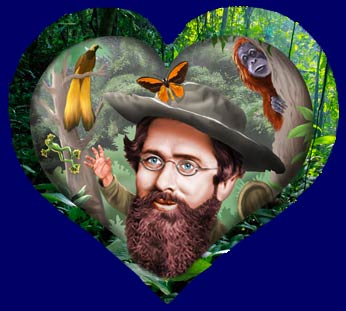
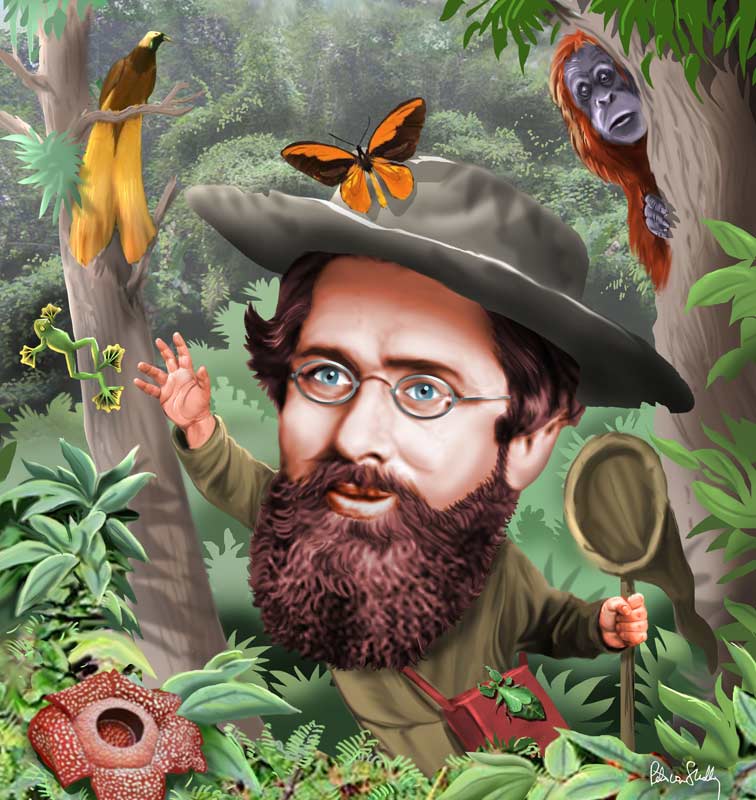
Alfred Russel Wallace by Peter Von Sholly
Click image to enlarge
� Peter Von Sholly
Celebrating the Life of Alfred Russel Wallace
Alfred Russel Wallace (1823�1913), a brilliant field naturalist, biologist, and author, almost scooped Charles Darwin in announcing the theory of evolution by natural selection to the world.
In 1858, alone in the jungles of Indonesia, Wallace conceived the theory during a malarial attack. Upon recovering, he wrote it down and mailed it to the naturalist he most admired�Charles Darwin, who was living in the English countryside. Darwin was thrown into a panic, fearing that �all his originality will be smashed.� Yet he said he would �rather burn my own book� than for anyone to think �that I take anything from Wallace.�
Their papers were presented jointly at the Linnean Society of London in 1858, with neither man attending, and it touched off a revolution in biology. The Darwin-Wallace theory, as it was originally called, was published that same year; Darwin�s greatly expanded version, On the Origin of Species appeared in 1859. However, although Wallace became well known during his lifetime, after his death in 1913, he receded from public memory until history had nearly forgotten him. That situation has been changing for the past few years as scholars, philosophers, historians, and biographers have begun to appreciate the riches of his intellectual legacy.
The Alfred Russel Wallace Centenary Celebration, with funding from the John Templeton Foundation, is part of this global attempt to understand and contemporize Wallace. Our programs support the collection and digitizatiion of thousands of Wallace letters, scholarly conferences open to the public, and special lectures and publications. For an account of Wallace�s life and work, see Alfred Russel Wallace (1823�1913), a Biography.
The Centennial Celebration at the American Museum of Natural History 2013
On November 12, 2013, a major conference on Wallace was held at the American Museum of Natural History in New York City, featuring eight visiting lecturers and an evening presentation by the dean of natural history broadcasters, Sir David Attenborough (see slideshow below). The wonderful clip from the BBC, with Sir David voicing the lyrics to �What a Wonderful World� over scenes from nature brought a standing ovation from the audience. Someone remarked that there are now two iconic versions of that song: the Louis Armstrong version and the Attenborough version. See and hear for yourself!
David Attenborough: �What a Wonderful World� BBC Video
Click in control bar for full screen, Esc to return.
A Slide Show of the David Attenborough Lecture
The Ten Lectures
at the Wallace Centenary Celebration
American Museum of Natural History
November 12, 2013 Go to the Playlist on YouTube
(or select from the
individual presentations below)
Three Birds of a Feather: Darwin, Wallace, and Attenborough An Unbroken Tradition of Finding Where the Wild Things Are By Richard Milner
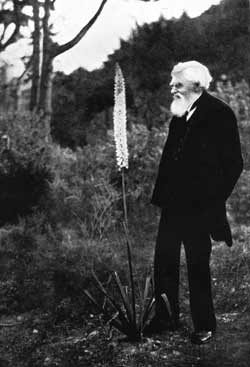
Alfred Russel Wallace
Wisdom begins in wonder. �Socrates
The natural world is the greatest source of excitement; the greatest source of visual beauty; and the greatest source of intellectual interest. �Sir David Attenborough
Singly and collectively, three of Britain�s greatest naturalists, Charles Darwin, Alfred Russel Wallace, and�a century later�Sir David Attenborough, were all profoundly moved by wonder and awe in the midst of remote tropical forests. Those defining experiences set the course of their lives as observers and explorers of the natural world�and inspired their passion to understand and interpret it for the rest of us.
Darwin�s initial exposure to a Brazilian rain forest in 1832 evoked this ecstatic reaction in his Diary:
The day has passed delightfully: delight is however a weak term for such transports of pleasure: I have been wandering by myself in a Brazilian forest. . . . The delight one experiences in such times bewilders the mind. �if the eye attempts to follow the flight of a gaudy butter-fly, it is arrested by some strange tree or fruit; if watching an insect one forgets it in the stranger flower it is crawling over. . . . The mind is a chaos of delight . . . . To a person fond of Natural history such a day as this brings with it pleasure more acute than he ever may again experience . . . it is nearly impossible to give an adequate idea of the higher feelings which are excited; wonder, admiration & sublime devotion fill & elevate the mind. (Darwin 2001:42,59)
Diverse life forms of the sea and shore, too, amazed and delighted the twenty-three-year-old naturalist:
Many of these creatures so low in the scale of nature, are most exquisite in their forms & rich colours. �It creates a feeling of wonder that so much beauty should be apparently created for such little purpose. (Darwin 2001;22)
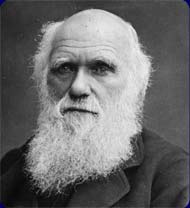
Charles Darwin
When Darwin�s rapturous descriptions of his travels aboard HMS Beagle were read by Alfred Russel Wallace, a daydreaming amateur naturalist fourteen years his junior, the younger man was inspired to embark on his own dangerous odyssey through the tropics. Wallace�s accounts of his eight years as a field naturalist in southeast Asia and four years in the Amazon echo the same unremitting enthusiasm of a naturalist�s adventures and discoveries.
Wallace also unknowingly followed Darwin�s lead in theorizing about the origin of species, independently developing the theory of natural selection, which the senior naturalist had written out more than fifteen years earlier. While still in the jungles of Indonesia, he sent a paper on the subject to Darwin, who was thrown into a panic for fear of being scooped. He rushed to complete his book on the subject in thirteen months, after a decade and a half of procrastination. Their papers were presented jointly at the Linnean Society of London in 1858, with neither man attending, and the Darwin�Wallace theory, as it was originally called, was published that same year; Darwin�s book-length treatment, On the Origin of Species,�followed in 1859. Their work touched off a revolution in the life sciences that continues today.
Last year, 2013, was the hundredth anniversary of Wallace�s death�an anniversary that impelled scientists and historians to re-evaluate and celebrate the achievements of this extraordinary field naturalist who became Darwin�s friendly rival. As part of a Wallace Centenary Celebration this past November, I was privileged to bring Sir David Attenborough, the great wildlife filmmaker and broadcaster, to New York, where he lectured to an overflow crowd on his hero �Alfred Russel Wallace and the Birds of Paradise� at the American Museum of Natural History.
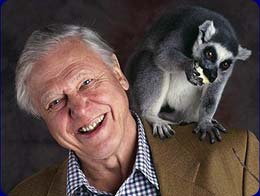
Sir David Attenborough and friend
In his talk, Attenborough sketched some of the differences between Darwin and Wallace. While Darwin�s voyage aboard HMS Beagle was financed by his wealthy father, Wallace had to support his expeditions by collecting thousands of specimens for sale to museums and collectors; Darwin was Cambridge-educated, while Wallace was self-taught; Darwin did not seek a theory when he set sail, while Wallace deliberately set out to gather evidence for or against the idea of the �transmutation� of species.
However, although both were architects of the theory of natural selection, they held opposing views on human evolution. Wallace was a spiritualist who favored �guided� evolution of human cognition, provoking Darwin to respond in 1869, �I differ grievously from you, & I am very sorry for it . . . I hope you have not murdered too completely your own and my child.� (Darwin 1869). Eventually, Darwin�s insistence on a completely naturalistic framework for interpreting evolution prevailed over Wallace�s more mystical view.
But what unified them and bonded them as brothers under the skin was not only a shared interest in science and evolutionary theorizing; it was that same sense of awe and perplexity, that same mind-bending, toe-curling passion for the marvels of nature.
Wallace recounts in his classic book The Malay Archipelago how he could nearly swoon with delight over a single butterfly as well as an entire forest: �I found . . . a perfectly new and most magnificent species . . . . The beauty and brilliancy of this insect [Wallace�s golden birdwing] are indescribable, and none but a naturalist can understand the intense excitement I experienced. On taking it out of my net and opening the glorious wings, my heart began to beat violently, the blood rushed to my head, and I felt . . . like fainting . . . so great was the excitement produced by what will appear to most people a very inadequate cause� (Wallace 1869:2:51).
As for his immediate impetus to launch an eight-year expedition to the jungle islands of Indonesia, then known as the Malay Archipelago, Wallace became obsessed with finding two almost mythical creatures: orangutans, because they were so elusive, rare, and humanlike, and birds of paradise because they were so drop-dead gorgeous and their bizarre courtship behavior so spectacular. Their incredible plumage had been seen occasionally in Europe as far back as the 1500s and had even became incorporated into Royal finery, but nary a single live specimen ever reached England.
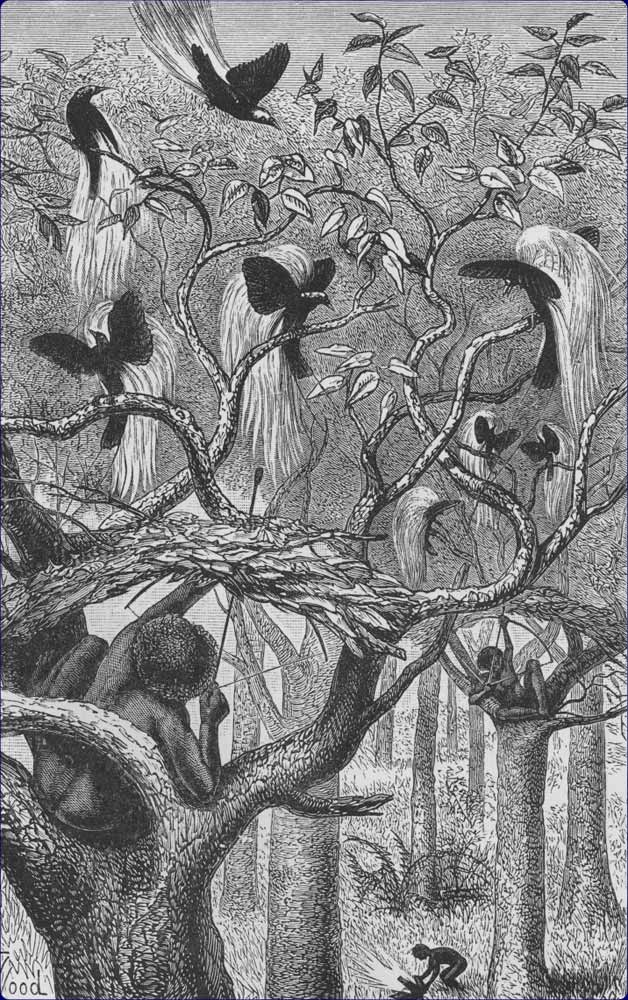
Aru hunters shoot displaying Birds of Paradise with blunt-tipped arrows, so as not to pierce the valuable skin. (From Wallace�s book The Malay Archipelago, 1869) Click image to enlarge.
Because the birds� skins were shipped from remote jungles to Europe with their feet cut off, a tale arose that they flew around in Paradise never perching or landing, and subsisted exclusively on �Celestial dew.� Wallace didn�t buy that preposterous tale, of course, but became obsessed with tracking down real birds of paradise in the wild. One fateful day in 1857, in the Aru Islands, a group of tribal bird hunters led him to a forest glade where the birds were known to perform their courtship displays all year round. Wallace, the first European to witness this greatest of all avian spectacles, drank in the scene as his reward for years of struggle and deprivation and later described it in The Malay Archipelago:
[T]wenty full-plumaged male birds assemble together, raise up their wings, stretch out their necks, and elevate their exquisite plumes, keeping them in a continued vibration . . . . [t]hey fly from branch to branch in great excitement, so that the whole tree is filled with waving plumes in every variety of attitude and motion . . . the Bird of Paradise really deserves its name, and must be ranked as one of the most beautiful and most wonderful of living things. (Wallace 1869:2:252�253)
As a young boy, Sir David told his audience, he read that breathless, wide-eyed description of Wallace�s in The Malay Archipelago and immediately decided that one day he must see those remarkable dancing birds for himself. Attenborough was also taken with Wallace�s musings from his account of the search for the birds, from his autobiography:
Nature seems to have taken every precaution that these, her choicest treasures, may not lose value by being too easily obtained. First we find an open, harbourless, inhospitable coast, exposed to the full swell of the Pacific Ocean; next, a rugged and mountainous country, covered with dense forests, offering in its swamps and precipices and serrated ridges an almost impassable barrier to the central regions; and lastly, a race of the most savage and ruthless character . . . . In such a country and among such a people are found these wonderful productions of nature. In those trackless wilds do they display that exquisite beauty and that marvellous development of plumage, calculated to excite admiration and astonishment among the most civilized and most intellectual races of man. (Wallace 1905:1:394)
While today Wallace is feted for such scientific achievements as mapping the worldwide distribution and evolution of animals and plants, what impressed young David Attenborough most was his excitement and wonder at the incomprehensible strangeness and complexity of the living world, which kept Wallace in a permanent state of awe. Even though he went on to become the co-founder of the Darwin-Wallace theory of evolution by natural selection, Wallace believed that the natural world presented phenomena always a bit beyond scientific understanding, and that we should keep striving to explore its mysteries.
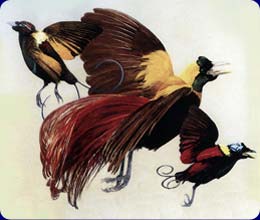
Birds of Paradise, Raymond Ching � 2012
Like Wallace, Attenborough is especially fascinated, even haunted, by birds of paradise because they are so very different from primates and from each other. The great variety of plumage, colors, and remarkable courtship dances of these closely related, glorified crows fills him�as it did Wallace�with wonder about how evolution could have produced them, and also how irrelevant humans are to the whole process. Both naturalists, more than a century apart, are humbled and inspired by the sheer exuberance and vitality of the life force and its expression.
Ultimately it was Wallace�s quest for the King bird of paradise�not a search for evolution theory�that drew him to press on through thousands of miles of jungle wilderness. Following in Wallace�s footsteps, Sir David gave up a lucrative, prestigious job running the BBC (he brought color television to Britain) to return to filming spectacular animals and plants in the world�s last remaining wild places. Let�s give Wallace and Attenborough the final words on the subject. First Wallace, from The Malay Archipelago:
[O]ne of my objects in coming . . . was accomplished. I had obtained a specimen of the King-Bird of Paradise . . . . The remote island in which I found myself . . . in an almost unvisited sea . . . . the wild luxuriant tropical forest . . . the . . . savages who gathered round . . . all had their influence in determining the emotions with which I gazed upon this �thing of beauty.� I thought of the long ages of the past, during which the successive generations of this little creature had run their course . . . being born, and living and dying amid these dark and gloomy woods, with no . . . [appreciative human] eye to gaze upon their loveliness . . . . [Yet] should civilized man ever reach these distant lands, and bring . . . light into the recesses of these virgin forests, we may be sure that he will so disturb the nicely-balanced relations of . . . nature as to cause the disappearance, and finally the extinction, of these very beings whose . . . beauty he [alone] . . . is fitted to appreciate and enjoy. This consideration must surely tell us that all living things were not made for man. Many . . . have no relation to him. The cycle of their existence has gone on independently of his . . . and their happiness and enjoyments, their loves and hates, their struggles for existence, their vigorous life and early death, would seem to be immediately related to their own well-being and perpetuation alone. . . . (Wallace 1869:2:222�224, emphasis in original)
And now Attenborough from a YouTube interview posted in 2013:
Birds of paradise, which I just happen to just be obsessed by . . . You look at the variety of plumage and the variety of coloration . . . . [They�re all so incredibly different that you] have to kick yourself to believe they all evolved within the same family until you look at the females and then you suddenly see that if you can strip away the male sexual display element�they are very, very similar�then the reality comes home to you. But it�s quite a hard effort. Gorillas are fascinating because they are so like us. I can imagine what it�s like to be a gorilla. I really can . . . . But when you look at birds of paradise you realize that there�s a whole aspect of life, of liquidity, the essence of life which has got nothing to do with humanity, and which has been going on before primates even appeared on Earth. But it�s when you sit concealed in a hide and you see the complexity of the natural world . . . . with these extraordinary manifestations, which strike you, subjectively, as being amazingly beautiful, and you see all that pullulating with vigor and variety and passion, that you see that humanity is not dominant in the world, and is only a very small part of it . . . And that�s what I find moving.
Sir David�s sixty-one years of exploring and filming the natural world has been a direct continuation of the work begun by the great Victorian naturalists. In keeping alive the flame of their vision and passion, the torch has been passed directly from Darwin to Wallace to Attenborough.
The prolonged standing ovation Sir David received at the American Museum was only partly for his colorful and inspiring lecture; it was really the audience�s heartfelt appreciation and gratitude for his life�s work in bringing home to us the Darwin-Wallace tradition and connecting us with Earth�s natural wonders, which has so enriched our own lives.
References
Attenborough D. 2009. David Attenborough on birds of paradise [Internet]. Nature Videos; [cited 2014 May 6].
�����Available from https://www.youtube.com/watch?v=pHyLdYIDAb0
Darwin, C.R. 1869, April 14. [Letter to Alfred Russel Wallace.]
�����Available from http://www.darwinproject.ac.uk/letter/DCP-LETT-6706.xml
Darwin, C.R. 2001. Charles Darwin�s Beagle Diary. Keynes RD, editor. Cambridge: Cambridge University Press.
Wallace, A.R. 1869. The Malay Archipelago, 2 vols. London: Macmillan.
Wallace, A.R. 1905. My Life: A Record of Events and Opinions, 2 vols. London: Chapman and Hall.
About the Author
Richard Milner is Associate in the Division of Anthropology at the American Museum of Natural History; among his books are Darwin�s Universe: Evolution from A to Z (Berkeley, CA): University of California Press, 2009) and Charles R. Knight: The Artist Who Saw Through Time (New York: Abrams, 2012). He is the director of the ongoing Alfred Russel Wallace Centenary Celebration, supported by the John Templeton Foundation, which sponsored Sir David Attenborough�s lecture �Alfred Russel Wallace and the Birds of Paradise� on November 12, 2013, at the AMNH. The Wallace Centenary Celebration also sponsored a West Coast public conference on November 15, 2014 at UCLA.
This essay (along with James T. Costa�s �Rediscovering Wallace�s �Species Notebook��) appeared May 2014 in a special Wallace issue of Reports of the National Center for Science Education, Vol 34, No. 3, both printed and online.
Author�s email: [email protected]
What is Wallace�s Line?
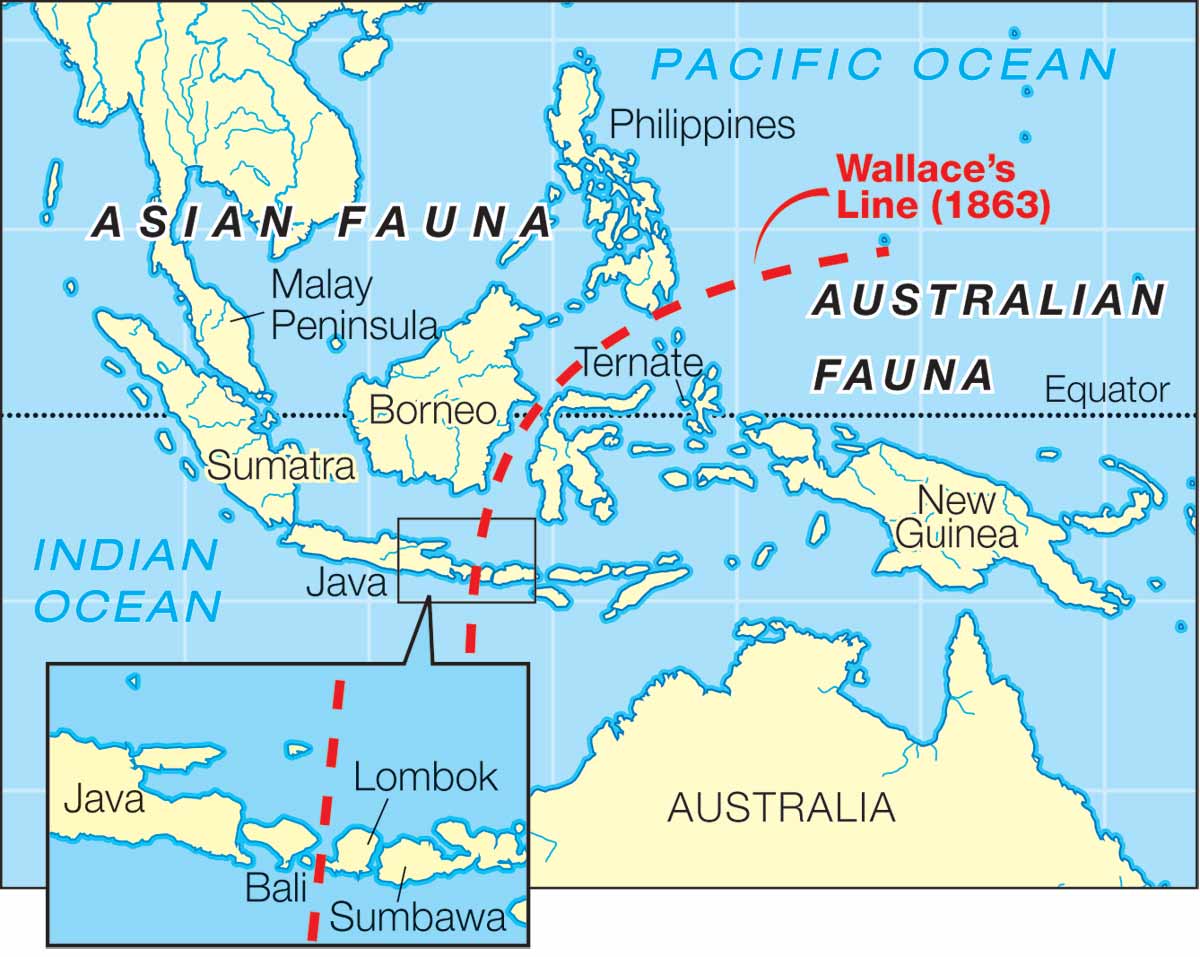
Map of faunal break between Lombok and Bali by Joe LeMonnier
Click image to enlarge.
British naturalist and explorer Alfred Russel Wallace independently invented the theory of evolution by natural selection in 1858, nearly scooping Charles Darwin. Although Wallace has been overshadowed by Darwin in the history of evolutionary biology, an�other of Wallace�s brilliant discoveries is still enshrined on every biologist�s map of the world�Wallace�s Line.
After years in the Amazon and Malaysian jungles observing wildlife,
Wallace attempted to make sense of their distribution. While exploring the vast 2,500-mile Malay Archipelago, he noticed what kinds of animals lived on each island as he traveled farther from the mainland peninsula.
In 1869, he wrote, �I have arrived at the con�clusion that we can draw a line among the islands, which shall so divide them that one-half shall truly belong to Asia, while the other shall no less certainly be allied to Australia.� To the east of the Line are animals that came from the Australian continent, where they had originally evolved, while west of the Line the fauna is derived from Asia. Wallace�s Line runs a twisted course along a narrow strait between the islands of Bali and Lombock, and between Borneo and the Celebes group.
In The Geographical Distribution of Animals (1876), Wallace worked out his distribution theory more completely. Islands west of the Line were once connected, he thought, but even at that remote time the eastern islands were isolated from the western by a very deep channel�much deeper than the waters that separate the other islands.
Wallace had no way to observe the sea floor directly, and in his day nothing was known of tectonic plates. On the basis of animal distribution alone he deduced that the eastern island groups must have been separated from the western for much longer than any individual islands were separated from each other. A hundred years later, geologists and oceanographers found the reason and the proof: Wallace�s Line lies precisely on the perimeter of an area of intense crustal activity, now known as the Indo-Australian plate. Australian and Asian animals had been evolving independently for millions of years on separate continents, while the land masses they occupied were slowly moving closer and closer together. Finally, only a narrow channel of water remained between them�a marker of �Wallace�s Line.�
The Animated Life of A.R. Wallace
This short film in clever paper puppet animation celebrates the discoverer of natural selection, Alfred Russel Wallace. It was produced in honor of the centenary of Wallace�s death by Flora Lichtman, a video journalist, working with animator/filmmaker Sharon Shattuck, both of New York. The delightful film appears here courtesy of their kind permission.
Click in control bar for full screen, Esc to return.
The Forgotten Story of Alfred Russel Wallace Narrated by David Attenborough
From a YouTube video posting by Terry Melloy ~ Click in control bar for full screen, Esc to return.
�Truth is born into this world only with pangs and tribulations
.�.�.�every fresh truth is received unwillingly.�
�Alfred Russel Wallace, 1913
Alfred Russel Wallace Centenary Celebration Events
American Museum of Natural History in New York, November 12, 2013. �Natural Selection and Beyond.� Evening lecture by Sir David Attenborough on �Alfred Russel Wallace and the Birds of Paradise.�
Second Public Conference: UCLA, November 15, 2014. Feelie Lee, Director. Speakers included Frans De Waal, Andrew Berry, Soraya de Chadarevian, Jared Diamond, Barbara Natterson-Horowitz, Tim Laman and Edwin Scholes, Wade Davis, Michael Shermer, and Ed Larson. See a listing of the speakers, topics, and bios for the UCLA Alfred Russel Wallace Centennial Celebration.
Ed Larson
Frans de Waal
Barbara Natterson-Horowitz
Tim Laman
On November 12, Richard Milner gave an invited lecture to UCLA�s Department of Ecology and Evolutionary Biology (see his lecture on the Wallace Channel).
Also at UCLA:
First University Seminar on Alfred Russel Wallace. Graduate seminar on the naturalist�s life and thought was taught by Distinguished Professor Patricia Gowaty in UCLA Dept. of Ecology and Evolutionary Biology, Spring 2014.
Tours of UCLA Botanical Gardens for school children K-12, became popular as Wallace Walks conducted by grad students as docents.
Darwin Day Celebration
and a Valentine to Alfred Russel Wallace
The North Carolina Museum of Natural Sciences
February 14, 2015
Darwin Day and Wallace talks were co-sponsored by the National Evolutionary Synthesis Center and the John Templeton Fund.
Kari Wouk, in charge of Collaborative Educational Programs at the NC Museum, wrote:
�Best Darwin Day ever!! We blew past last year�s record attendance of 4,316 and had 5,497 visitors! it was amazing! Clearly, there is a desire from the public to learn more about science history and evolution! Hurray! Thank you so much for your part in making this day so special.�
Presentations
Wallace Treasures from London's Natural History Museum
George Beccaloni & Ruth Benny ~ The Natural History Museum, London
A video presentation about Wallace's life and major scientific discoveries showing some of his priceless manuscripts and natural history specimens from the collection of London�s Natural History Museum. Wallace, Darwin, and Spiritualism: The Trial of the Spirit-Medium Henry Slade, 1876
Richard Milner ~ American Museum of Natural History
In 1876, England�s two greatest naturalists took opposing sides when the supernatural went on trial. Wallace and Darwin on the Evolutionary Trail
Jim Costa ~ Highlands Biological Station & Western Carolina University
An exploration of the intellectual journeys of Alfred Russell Wallace and Charles Darwin as they set out to amass evidence to support their conviction that species change over time. Wild Connection: The Animal Pocket Guide to Dating
Dr. Jennifer Verdolin ~ Author of Wild Connection
Whether it's the blue-footed booby, the adzuki bean beetle, or a slew of other species, animals have a lot to teach us about love and relationships. How Animals Choose (and Confuse) Their Mates
Courtney L. Fitzpatrick ~ National Evolutionary Synthesis Center (NESCent)
This presentation will give a brief survey of interesting examples of mate choice (and deception) in the wild. Sex on Six Legs: Lessons on Life, Love, and Language from the Insect World (Keynote)
Marlene Zuk, PhD ~ College of Biological Sciences, University of Minnesota
Insects are capable of incredibly complex behavior, even with brains often the size of a poppy seed. How do they accomplish feats that look like human activity with completely different pathways from our own?
Coming This Spring:
New Features From The Wallace Correspondence Project at London�s Natural History Museum
George Beccaloni, Director, Wallace Correspondence Project
Funded by the John Templeton Foundation
The following features will be added to the site and links to them posted:
Brief biographies of hundreds of Wallace�s friends, colleagues, and correspondents
All of Wallace�s nearly 200 surviving meticulous drawings of fish specimens he collected on the mighty Rio Negro in Brazil
Two field notebooks kept by Henry Walter Bates, Wallace�s partner while exploring the Amazon, including many beautiful watercolors of insects never before shown publicly
Videos of Talks Given at the UCLA Alfred Russel Wallace Centennial Conference
November 15, 2014, University of California, Los Angeles
Feelie Lee, Director of UCLA events
Funded by the John Templeton Foundation
Featuring Andrew Berry, Wade Davis, Saroya de Chadarevian, Frans De Waal, Jared Diamond,
Tim Laman, Edward Larson, Barbara Natterson-Horowitz, Edwin Scholes, and Michael Shermer
Coming Next Year:
The A. R. Wallace Correspondence Project (WCP), based at London�s Natural History Museum and directed by George Beccaloni: thousands of Wallace letters are being digitized, annotated, and made available to the public online.
Wallace Letters Online, the project�s online archive of Wallace�s correspondence and other manuscripts.
Special Wallace issues of two magazines will be produced next year: Natural History magazine and Skeptic magazine.
Also next year, a national book publisher will produce a major book on Wallace containing original contributions by the Centenary Celebration participants and other writers and scholars.
Welsh photographer Fred Langford Edwards will receive support for his ongoing Wallace Projects and Exhibitions, specifically to produce educational videos about Wallace aimed at Welsh schoolchildren. Some of his images will appear in the finished conference videos.





 in control bar for full screen, Esc to return.